 Add to Chrome
 Add to Firefox
 Add to Edge
IQuest-Coder-V1 Technical Report
Mar 17, 2026
In this report, we introduce the IQuest-Coder-V1 series-(7B/14B/40B/40B-Loop), a new family of code large language models (LLMs). Moving beyond static code representations, we propose the code-flow multi-stage training paradigm, which captures the dynamic evolution of software logic through different phases of the pipeline. Our models are developed through the evolutionary pipeline, starting with the initial pre-training consisting of code facts, repository, and completion data. Following that, we implement a specialized mid-training stage that integrates reasoning and agentic trajectories in 32k-context and repository-scale in 128k-context to forge deep logical foundations. The models are then finalized with post-training of specialized coding capabilities, which is bifurcated into two specialized paths: the thinking path (utilizing reasoning-driven RL) and the instruct path (optimized for general assistance). IQuest-Coder-V1 achieves state-of-the-art performance among competitive models across critical dimensions of code intelligence: agentic software engineering, competitive programming, and complex tool use. To address deployment constraints, the IQuest-Coder-V1-Loop variant introduces a recurrent mechanism designed to optimize the trade-off between model capacity and deployment footprint, offering an architecturally enhanced path for efficacy-efficiency trade-off. We believe the release of the IQuest-Coder-V1 series, including the complete white-box chain of checkpoints from pre-training bases to the final thinking and instruction models, will advance research in autonomous code intelligence and real-world agentic systems.

Local Contrastive Learning for Medical Image Recognition
Mar 24, 2023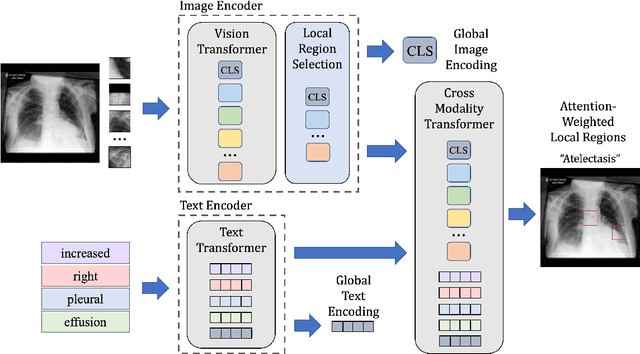

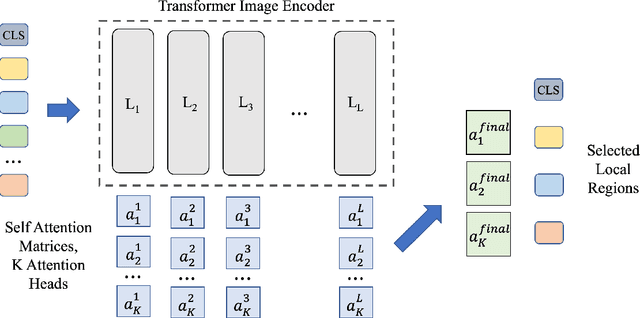
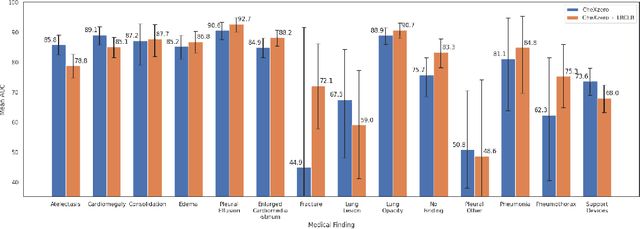
The proliferation of Deep Learning (DL)-based methods for radiographic image analysis has created a great demand for expert-labeled radiology data. Recent self-supervised frameworks have alleviated the need for expert labeling by obtaining supervision from associated radiology reports. These frameworks, however, struggle to distinguish the subtle differences between different pathologies in medical images. Additionally, many of them do not provide interpretation between image regions and text, making it difficult for radiologists to assess model predictions. In this work, we propose Local Region Contrastive Learning (LRCLR), a flexible fine-tuning framework that adds layers for significant image region selection as well as cross-modality interaction. Our results on an external validation set of chest x-rays suggest that LRCLR identifies significant local image regions and provides meaningful interpretation against radiology text while improving zero-shot performance on several chest x-ray medical findings.
Multiple Categories Of Visual Smoke Detection Database
Jul 30, 2022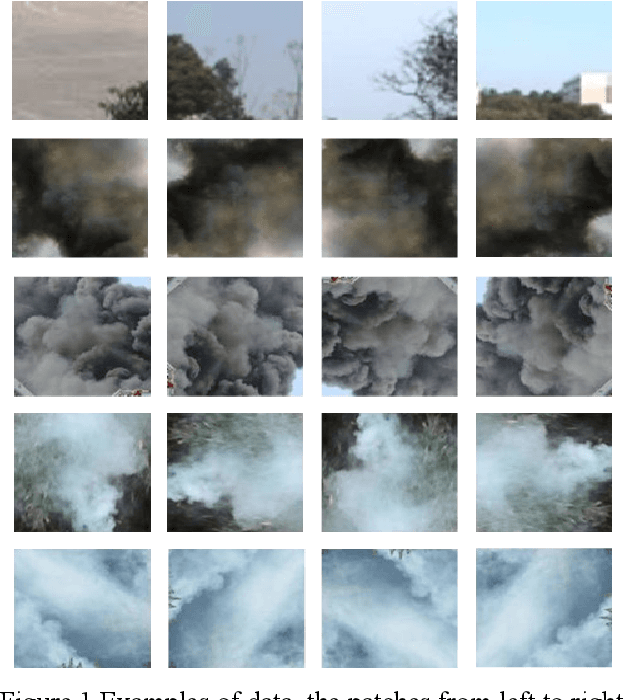
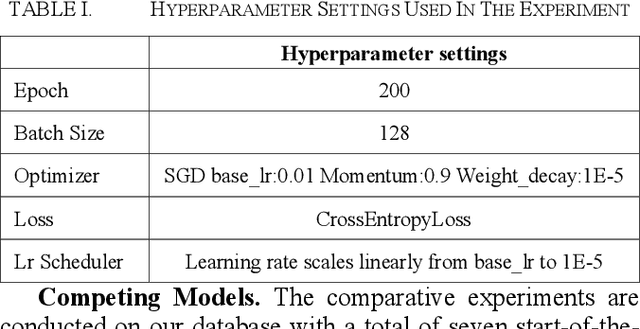
Smoke detection has become a significant task in associated industries due to the close relationship between the petrochemical industry's smoke emission and its safety production and environmental damage. There are several production situations in the real industrial production environment, including complete combustion of exhaust gas, inadequate combustion of exhaust gas, direct emission of exhaust gas, etc. We discovered that the datasets used in previous research work can only determine whether smoke is present or not, not its type. That is, the dataset's category does not map to the real-world production situations, which are not conducive to the precise regulation of the production system. As a result, we created a multi-categories smoke detection database that includes a total of 70196 images. We further employed multiple models to conduct the experiment on the proposed database, the results show that the performance of the current algorithms needs to be improved and demonstrate the effectiveness of the proposed database.